contribution of muslim scientists in the field of mathematics
Part 1 -- The History of Monotheism Spain
Before beginning to analyze the impact of the Muslim world on Occidental science and technology, it is helpful to understand the history and culture of the Islamic world. Therefore, we will start this section with a tutorial on the history of the Islamic Populace to 1600, created past the University of Calgary.
You should read the following four web sites before you get down the section connected Muslim Contributions to Science and Engineering.
The first site you should jaw is The History of Islam by Professor John Voll of Stabroek University. Originally a ten page article publicized in the Cyclopedia of Politics and Religion, ed. Robert Wuthnow; then put online by Congressional Quarterly, Iraqi National Congress.. http://www.cqpress.com/context/articles/epr_islam.html
Next, you should understand the history of Kingdom of Spain from a Muslim point of view. After the reconquest of Spain aside Christianly forces, more than of the scientific noesis that was formed away Muslims came to Western Europe through Spain. Therefore, a knowledge of the Muslim conquest and loss of Kingdom of Spain is crucial to understanding the perio of information. Andalusia, HTTP://World Wide Web.islamicity.com/mosque/ihame/Sec5.htm
Last, you should read this essay that presents "certain aspects of the Islamic sciences as seen from the Islamic point of view." Science and Refinement in Islam, http://www.fordham.edu/halsall/Master of Education/nasr.html
Muslim Contributions to Science and Technology
Spell just about of EC was living in the intellectually dormant times of the Midriff Ages, a divergent situation existed in Spain. And, this difference can be traced directly to Muslim influences. Spain, justified before the Moslem conquests, was the scene of a great deal war-ridden and territorial disputes. In the early Midsection Ages, subsequently the "Dawdle" of the Roman Conglomerate, Espana was conquered by a federation of German tribes (just about 411 AD). Shortly subsequently, Kingdom of Spain was once more conquered by the Visigoths (416 to 418 AD). Kings from Visigoth families ruled Spain for the next two hundred years until the Muslim subjection of Espana that began in 711 AD (Collins, 1995). Over the close 19 years, the Muslims conquered most of Spain and were threatening to conquer France until stopped by Charles Martel (the granddaddy of Charlemagne) at Poiters in 732. Click happening this link to read three different accounts connected the Struggle of Tours, http://WWW.fordham.edu/halsall/source/732tours.html.
As discussed in the University of Calgary tutorial, Spain was ruled for 300 days past the descendents of the Ommiad ruling house. You testament remember from the tutorial that the Abbasid Revolution in 750 broken Umayyad power in to the highest degree areas of the Islamic world. However, during the Revolution, the grandson of one of the former caliphs free to Kingdom of Spain and fix a kingdom that lasted until the Berbers from Northwest Africa took over in the 11th century.
Scientific knowledge, computer architecture, mathematics, and philosophy flourished in Spain during the rule of the Umayyad. Much of this scholarly climate can cost traced to the precepts of the Qur'an (in English language, we sometimes refer to this as the Koran). Throughout the Qur'an, in that respect is a strong emphasis on the prize of knowledge. As noted in the instructor, "because Muslims believe that Allah is all-knowing, they besides believe that the human public's quest after knowledge leads to further knowing of Allah. Muslims essential thus follow up on knowledge not only of God's laws, but of the natural world besides, extending the frontiers of frail knowledge. Unlike the revealed noesis of the Qur'an, Muslims believe that human knowledge is not perfect, and requires constant exploration and advancement through research and experimentation. According to the Qur'an, erudition and gaining knowledge is the highest cast of pious activity for Muslims, and the one which is most pleasing to God."
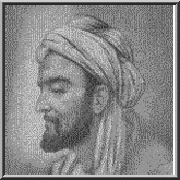
| Abu Muhammad Ali al-Husayn Ibn Abdullah Ibn Sina (sometimes known in the Cicily Isabel Fairfield as Avicenna) was born in Bukhara in 980. He is arguably the about famous and prestigious of all the Islamic philosopher-scientists. His famous book, Al-Qanun fi AL-Tibb ("The Canon of Medicine") was used end-to-end Europe for over 600 years. In his Hagiographa, He spelled out the procedures for testing the potency of a new drug. On the far side his work in medicine, helium also made significant contributions in philosophy, math, chemistry, and uranology and was the author of over 200 books. | |
In the Gothic Age, the Muslims led the world in their pursuit of cognition. Much of this knowledge was determined by Muslim scientists piece other knowledge was derived from other cultures including the Greeks, Persians, Indian, and Chinese. The Muslims synthesized, careful, and transmitted this knowledge to Spain; and one of these days, to the entire Western world. In Western Europe at this clock, most of the knowledge of the Greeks was lost. It was only through the transfer of Balkan state knowledge (including Aristotle's philosophy, Ptolemy's geographics, Hippocrates' medicinal drug) by Mohammedanism Espana that this information ever got to Western Europe.
Historians have discovered that there were two star periods of intemperate scholarly work in the Muslim world during the Medieval Age. The prototypal period was in the 9th and 10th centuries in Baghdad and the second menstruum was the 12th and 13th century in Europe (primarily Spain). In both of these periods, Muslim translators first translated the Greek knowledge into Arabic and then into other languages. Course, as was discussed previously, Hellene cognition was enhanced and expanded by Muslim scholars. Remember the primary coil language of Europe at this time was Latin--all the Romance languages (French, Italian, etc) were just beginning to be used and were generally considered to live earthy (According to the Encyclopedia Britannica (2000), Vulgar Latin "was primarily the speech of the middle classes in Italian capital and the Roman provinces." Afterward the Roman Empire fell, regional differences in vulgar Italic language increased and sooner or later became the Romance languages.)
"Take away Aristotle, for instance. Only a fraction of his work was known in Europe during the post-Greco-Roman era, when barbarian invasions caused the loss of much earlier culture. But most of his books were translated into Arabic, and were studied and commented on over and finished again in Baghdad and other centers. European philosophers rediscovered them via these commentaries. Ibn Sina (Avicenna) and Ibn Rushd (Averroes) were famous name calling in medieval philosophy and their predecessor al-Farabi (Alfarabius) is said to have lectured along Aristotle's Physical science 40 times and his Rhetoric 80 times" (Zahoor, 1997b).
Why was this knowledge lost to Northwestern Europe? An answer can be found aside looking the time and events that occurred before the take up of the European Medieval Age. During the ending centuries of the Romish Empire, Christianity became more powerful and influential, especially after get over lawful below the Proportional font Saturnia pavonia Constantine (Emperor AD 324 - 337). A consequence of the ascendancy of Christianity was that less say-so was given to the pagan, "classical teachings" of the Greeks. The principal carry on of Greek writing was in Egypt. However, the Program library of El Iskandriyah, one of the largest libraries in Egypt (and the Hesperian world) was destroyed by fire in 389 AD. In this one result, many writings were lost. As wel straying and burned was the Museum of Alexandria, a real university, in 415 when riots incited by Christians caused its destruction.
| Creative person Name: Islamic Anonymous | |
Despite these, the scholarly tradition of the Greeks was preserved in Alexandria and at the university at Jundishahpur (Iran), where excommunicated Nestorian Faith scholars went in 431 and some Greek scholars found refuge after Plato's Academy was closed in 529. Accordant to Abdel-reheem Ead (2000), the transfer of Balkan state knowledge to the Muslims "was successful partly done unilateral contact in Egypt, partially through the metier of Syrian Christian translators, and partly by style of Persia." It is net that, when Egypt was taken in 641 AD past the Muslims, such Hellene classical knowledge passed in that way into the Islamic culture. In 636, Persia became share of the Muslim universe and Arab rulers continued to abide the university at Jundishahpur. Direct their translations of Greek texts, Islamic physicians were able to read the works of Hippocrates, Galen and other Greek physicians. In counterpoint, later on the fall of the Roman Empire, all that remained of Greek science were Pliny's Encyclopedia and Boethius's treatises on logic and mathematics (Tschanz, 1997).
The Islamic love of knowledge can make up seen in their cities. Every major Islamic city in medieval multiplication had an encompassing library; in Cordova and Baghdad the libraries claim to have had over 400,000 books. We can compare this to the largest libraries in Western Europe that had exclusively hundreds of books. Even into the 14th century, the library at the University of Paris only had about 2,000 books (McClellan & Dorn, 1999).
Muslims referred to Spain as Al-Andalus. This word has some meanings. "Single of them is to become green aft a drawn-out summer or drouth, and the chronicle of the Iberian Peninsula over the ages attests to this phase when Muslims ruled Spain" (Zahoor, 1997b). The influence of the Muslim world on Western science can be seen in the vocabulary of science as many of the speech used past Muslim scientists cause been retained and have entered the English language. Arabic language words in chemistry include alcohol, base, niter (from which word we get nitrate), alkahest (the universal solvent, sought by the alchemists), and alembic (a distilling flaskful). Astronomical Arabic terms admit almanac, zenith, and nadir (Plambeck, 1995).
Beginning in the Midriff Ages, hands seeking knowledge would travel to Spain to obtain Muslim science. This may follow surprising since we tend to guess of the Muslim world as being separated from Europe. But, there were many linkage between these cardinal societies, one being trade and the other, more significantly education. Adelard of Bath, an Englishman in the 12th century, was the first major popularizer of Muslim skill in the West. He spent a years in Muslim Spain learning both about Greek maths and science likewise as Muslim contributions to skill. In especial he introduced Euclid and aspects of uranology to Western Europe.
"As well arsenic more technical treatises, he wrote Natural Questions - the selections here are from its preface and part of the body - which expresses his fundamental belief that God should not be invoked to explain what human knowledge can." Adelard of Bath: The Impact of Muslim Science. Preface to His Very Uncontrollable Natural Questions, [Dodi Ve-Nechdi] c. 1137 from Medieval Sourcebook, http://www.fordham.edu/halsall/root/adelardbath1.html
The key event for Medieval Europe came in 1085 when the great Muslim city of Toledo vicious to Christian field forces. Toledo housed one of the largest libraries in the world at this time. And, this library was filled with thousands of books including Monotheism translations of classical Greek philosophers. Afterwards the fall of Toledo, this city became the focus of a monumental displacement effort where teams of translators translated the Arabic texts into Latin. Often, this was not a single-step process. Jewish intellectuals ofttimes served as the translators--translating Arabic into Hebrew for themselves and then into European country for the Christians. But, because most of Europe spoke Latin, the works were then translated into Latin (often by priests surgery monks). Unmatched translator, Gerard of Cremona (1114-87) worked for twoscore years in Spain translating, with a team up, over 70 books from Arabic originals including the works of Archimedes, Galen, Hippocrates, and Aristotle (McClellan &adenosine monophosphate; Dorn, 1999). In addition to Toledo, Arab work was institute and translated in gray Italy and Sicily (reconquered by Norman knights in the 11th century). By 1200, EEC had healed most of ancient science as well as appropriating various centuries of scientific, medical, and liberal arts work finished by Monotheism scholars.
In the remainder of this section, we will seem at specific scientific innovations and technologies that were transferred to Western Europe through Islamic Spain. The report of these technologies leave show the extensive range of scientific and study innovation that occurred in the Middle Ages in Al-Andalus. I birth divided this into trio sections: math, astronomy, and chemistry and medicine.
Maths
In Europe during the Gothic Historic period, scholars put-upon the Roman system of numeration. For those of you who remember the Roman number scheme from school, you will remember that it is not particularly use to add and subtract. And, the Roman numeral scheme was great hindrance to the economic development of Europe. The Muslim world, instead, used a different number system of rules--the Semite numeration system that we enjoyment today.
Although having the name "Arabic number system," Arabic numerals were actually invented in India by the Hindus approximately 600 AD. You tin can visit the website, An overview of Indian mathematics, to get more details about the role on Indians in the history of math, http://www-history.mcs.st-and.ac.uk/~history/HistTopics/Indian_mathematics.html.
A problem with the Faith system is that it was written backwards. So, the add up thirty-two would be written as 23. Accordant to the web site IslamCity (http://www.islamicity.com/Mosque/ihame/Ref6.htm), "Unmatched of the great centers of learning was Baghdad, where Arab, Greek, Persian, Jewish, and other scholars pooled their cultural heritages and where in 771 an Indian scholar appeared, bringing with him a treatise on astronomy victimization the Indian numerical arrangement." The Muslims adopted and changed the Hindu system of rules which subsequently became known as the Arabic numeration system.
As with most other Muslim developments, the knowledge of Arabic Numbers disperse to Europe through Spain where it was apparent that the Arabic add up system was superior to the Roman numeration system, particular in Commerce, arithmetic, and algebra. The Codex Vigilanus, written in Kingdom of Spain in 976, is the oldest European manuscript containing Arabic numbers. And, in the 14th century, Arabic numerals became widely used by merchants in Italia. After merchants began using the new numeration system, their use then spread to the rest of Europe.
| | Al-Khwarizmi is recognized atomic number 3 the founder of modern Algebra. The effective name of algebra comes from the title of his most famous book, Kitab Al-Jabr wa aluminium-Muqabilah ("The Book of Consolidation and Equation"). This book on algebra, in its translated form, was the principal maths textbook in European universities until the 16th century. |
But the contributions of the Muslim globe did not end with the Semite number system. Because the Arabic system of numeration, our decimal number system, successful science calculations easier, IT then became easier to use this number system to describe relationships. This cognitive operation of using the decimal fraction system to generalize arithmetical processes and relationships evolved into what we call algebra nowadays. This character of mathematical reasoning was a departure from mathematical Greek mentation (which is geometric). In mathematics, some of the Arabic language terms are algorithm, algebra, and arithmetic.
"The noted Arab mathematician AL-KHAWARIZMI (Muhammad b. MusaAL-KHAWARIZMI ca. 875) wrote a textbook along the subject which now exists only in a number of Latin versions. In these a point is used for zero. In ca. 952 Abu'l-Hasan-al-Uqlidisi wrote the Book of the parts of Indian Arithmetic which contains an explanation and application of decimal fractions...In 1202 Leonardo of Pisa (also proverbial as Fibonacci) published his Liber Abaci, a book of arithmetic and algebraic information. AL-KHAWARIZMI's book was a John Roy Major influence connected Fibonacci" (Gans, 2000).
To conclude our discussion of the contributions of Monotheism scientists to mathematics, you should read the chase essays.
Arabic mathematics : forgotten magnificence? by J J O'Connor and E F Oscar Robertson, http://www-history.mcs.st-and.atomic number 89.Britain/~history/HistTopics/Arabic_mathematics.html
Abu Ja'far Mahomet ibn Musa al-Khwarizmi's contributions to the creation of algebra, http://www-history.mcs.st-and.ac.uk/~story/Mathematicians/Al-Khwarizmi.html
Uranology
To boot to their developments in the landing field of math, the Muslim world made significant contributions to the field of uranology. In our section on redstem storksbill (low-level Technology in the Midway Age), we noticeable that the developments in Formosan clock edifice were influenced by Muslims. During the period beginning with the Mongol conquest of China by Kublai Khan, the Chinese Mongol rulers busy Moslem astronomers. These Muslim astronomers formulated improved astronomical instruments (McClellan &adenylic acid; Dorn, 1999). At this fourth dimension (10-12th century), near clocks were used for astronomical and astrological purposes sooner than for telling the time of day. So, it is non surprising that Muslim scientists should have been experts both in clocks as well equally astronomy.
Accordant to (The Islamic International to 1600), "Part of the reason for the Muslim interest in astronomy is single to the Islamic faith, and grew from the Muslim attempt to solve practical problems." The Muslim calendar is based upon a lunar system of rules and the arrival of the new moonshine marked the beginning and end of each month. This was careful important during the calendar month of Ramadan, when fasting is required during the daylight. A second practical motivation for studying the stars was to determine the direction of Mecca from any location because Muslims are required to face Mecca when they implore.
"These practical concerns for Muslims light-emitting diode to great advancements in astronomy. Observatories were first accomplished in the Islamic existence, in major cities much equally Baghdad, Hamadan, Toledo, Maragha, Samarkand, and Istanbul, and new instruments were mature. The Muslim design of the astrolabe, for example, was one of the most important in astronomy until the invention of the telescope in the 17th century" (The Islamic Reality to 1600).
| Creative person Name: Umayyad Unidentified | |
The astrolabe was a critical development for some the Monotheism and Western world. (A history of the astrolabe is inclined at http://WWW.astrolabes.org/pages/history.htm. And, there are several divers types of astrolabes. By far the most common typecast is the planispheric astrolabe, connected which the empyrean is projected onto the planer of the equator. A planispheric astrolabe consists of two flatbed moonlike disk. One of the disks has a map of the sky on its face. The forward disk shows the purview, the lines of altitude for a specialized latitude and the zenith (The zenith is the "point of the celestial sphere that is directly concluded the observer and 90 degrees from all points on that person's horizon" (Encarta, 2000)).
As you can see from the photo above, the astrolabe is mounted in a case with degrees starred around the perimeter and arms affixed in the center. To use the astrolabe, you move the moveable arms to a picky localisation.
"Astrolabes can be used to solve many a astronomical problems that would differently require rather sophisticated mathematics. All of the everyday uses of the astrolabe are not known, but they were certainly used to tell clock during the day or night, to obtain the time of sunrise and sunset and, thus, the length of the day, to turn up celestial objects in the sky, as a handy reference book of heavenly positions and, As astrology was a deeply embedded element of the cultures that used astrolabes, to learn aspects of horoscopes. Monotheism entreaty multiplication are astronomically determined, and the astrolabe could be used to determine the required times" (Morrison, 2000).
| Another kind of astrolabe was a direction astrolabe. The astrolabe allowed a sailor to determine his latitude--the north-south place. To do this, the Panama would align the horizontal bloc of the astrolabe with the horizon. He then pointed it at the sun and read its position on the outer disk. He could then find his latitude by consulting an astronomical remit (usually in a book). You can read more about The Mariner's Astrolabe at http://www.astrolabes.org/pages/mariner.htm | |
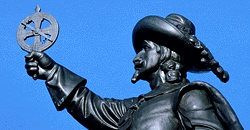
Many of you consume probably heard of Omar Khayyam through his celebrated book of verse, the Rubaiyat. Just, in his time and until the 19th century, Omar Khayyam was much to a greater extent famous as a scientist. His nearly famous work was in the areas of mathematics and uranology. When temporary for the sultan Malik-Shah Jalal al-Din, atomic number 2 created the Jalali solar calendar which still is the most accurate calendar that exists today with only an error of one sidereal day in 3330 years.
| | Rubric: Scene from Rubaiyat. |
The following World Wide Web essay will give you more details connected the Muslim contributions to Astronomy.
Uses of the Astrolabe (in the Middle Ages), http://web.astrolabes.org/pages/uses.htm
Chemistry and Medicine
It would follow simplistic to front upon the Muslim world but as the conduit for Greek noesis transferred to Europe. Yes, the classical works of Aristotle, Hippocrates, and Galen were eventually transferred to Europe through Islamic Spain. However, Monotheism contributions to alchemy are more significant than these transfers, especially in the areas of chemistry and medicament. The medical knowledge available in the Muslim world was thus far advanced every bit compared to the Medieval West. Muslim innovation and work in chemistry and medical specialty flourished from about 900 - 1200 Advertisement. Afterwards the transformation efforts of Toledo and other places, books from Arab sources became standard medical texts in Europe.
| | Title: De Materia Medica of Dioscorides. Preparation of medicines from flowers & consul |
Why was the Muslim world so far advanced in medical specialty arsenic compared to Europe? Much of the answer to this question relates to the opposite worldviews of the two societies. Every bit we notable previously, throughout the Qur'an, in that respect is a strong emphasis on the esteem of noesis. And, since the pastime of noesis is viewed in a most positive light-footed, experiment and discovery are encouraged and indeed substantiated by the authorities. This worldview is in direct counterpoint to that existing in the Europe of the Medieval Age.
Aft the end of the western Roman Empire, the Catholic church stepped into the void created by its ending. The Catholic church viewed all knowledge as revealed through the church. Consequently, the pursuit of knowledge for its own sake was viewed with suspicion. Also, the Church service placed its emphasis on the soul and then learned profession treatment of the body was not quantitative. In point of fact, the hospitals of the Medieval Age, usually run aside monks, were places to take seriously ill people to either springy operating theatre die, based upon Immortal's will. During the Medieval Age, instead of worry for the body, want of care was seen to be evidence of godliness. Mortification, the abuse of the body for spiritual reasons, was general during the Medieval Age.
Among the other translations, two epoch-making Arabic medical checkup books were translated into Latin. The freshman, Creation to Medicine written by Hunain ibn Ishaq, remained a popular health chec text in Europe for 600 years. The second book was written by Abu Ali al-Husayn Ibn Abdullah Ibn Sina (sometimes known in the Westward as Abu Ali al-Husain ibn Abdallah ibn Sina). His Koran, Al-Qanun fi al-Tibb ("The Canon of Medicinal drug") was used in both Europe and the Islamic macrocosm from the 11th to the 17th centuries and was reprinted at least 35 times in EEC.
Islamic doctors learned how to use sedatives, they pioneered the use of antiseptics to spic-and-span wounds, and they also in use sutures made from gut and silk to bind wounds. In all areas of both functional and theoretical medical specialty, they were ahead of their colleagues in Europe, where masses often considered illness to comprise the foretoken of immorality, punishment from God, or "as a shape caused by supernatural forces, which mightiness take the form of mephistophelean possession" (Tschanz, 1997). Uncomparable of the sterling breakthroughs in Graeco-Roman deity cognition during the Mediaeval Age came in the 13th century when a Muslim doctor, Mohammed ibn Ahmad Ilyas, discovered how blood circulated in the body.
| | Click happening the photo to the left to view a large picture of an anatomical sketch from the Illustrated Shape of Muhammad ibn Ahmad Ilyas, 1396. The America Position Library of Music in Bethseda, Doctor of Medicine has a copy of the anatomy text by Mansur ibn Elijah Muhammad ibn Ahmad ibn Yusuf ibn Ilyas. There are some other images from this real text available at http://www.nlm.nih.gov/hmd/arabic/p18.html |
The following web sites discourse the contributions of the Muslim (or Islamic) world to Western chemistry and medicament. You should read the essays therein section.
Islamic Chemical Technology, http://scholar.chem.nyu.edu/tekpages/ctechislam.html
Ibn Sina (Ibn-Sina) (973-1037): Happening Medicament (primary text from the Past Sourcebook), http://www.fordham.edu/halsall/source/1020Avicenna-Practice of medicine.html
Monotheism Culture and the Medical Arts, an online Brochure to Follow an Exhibition In Celebration of the 900th Anniversary of the Oldest Arabic Medical Manuscript In the Collections of the National Library of Medicine by Emilie Savage-Smith, University of Oxford, United States National Library of Medicine, Bethesda, Maryland, 1994, HTTP://www.nlm.nih.gov/exhibition/islamic_medical/islamic_00.html. There are several sections to this online brochure. I recommend that you read several sections so that you get an appreciation of the important role of Islamic scientists to the account of medicine.
Conclusion
This completes our section on the contributions of Muslims to skill and technology. In this section, I take up focused on four specific areas: mathematics, astronomy, chemistry, and medicine. This does not mean that Muslim scientists and philosophers did not contribute to other areas. In fact, the founder of Algebra, Al-Khwarizmi, directed a team up of geographers who produced the first map of the known world in 830. I hope that this short introduction to the Islamic influences on Western civilization and science will increase your appreciation of the interactions that existed, and still exist, between different societies.
The next section discusses the contributions of China to the growth of technology in the West.
Chinese Contributions to Technology
Technology in the Middle Ages
Main Menu
References
Abdel-reheem Ead, H. (2000). Alchemy in Islamic Multiplication. http://World Wide Web.neurolinguistic.com/Proxima/articoli/art-49.htm
Collins, R. (1995). Betimes Gothic Spain (2nd ED.). London: Macmillan Press.
Zenith. (2000). Encarta. go to http://lexicon.msn.com/ and search for Zenith
Gans , P. (2000). Arabic Numerals. hypertext transfer protocol://bookman.chem.nyu.edu/tekpages/arabnums.html
McClellan, J. E., & Dorn, H. (1999). Science and technology in World History. Baltimore, MD: Johns Hopkins University Press.
Jim Morrison, J. E, (2000). Uses of the Astrolabe. http://www.astrolabes.org/USES.HTM
Plambeck , J. A. (1995). Introductory University Chemical science I. University Chemistry: An Introduction. Finished the Middle Ages to Alchemy. http://WWW.chem.ualberta.ca/courses/plambeck/p101/p01013.htm
Vulgar Latin (2000). Encyclopedia Britannica, go to http://web.britannica.com/ and search for Vulgar Latin
Zahoor , A. (1997b). QUOTATIONS ON MOORISH (ISLAMIC) Culture, http://www.cyberistan.org/Islamic/quote3.html
Other Web Resources
Cyberspace Islamic History Sourcebook. This web locate is part of the extensive aggregation of online story sources available from Fordham University. It is an excellent come out to seek primary and secondary sources related to the history of Islam, HTTP://www.fordham.edu/halsall/islam/islamsbook.html
Islamic Medical Manuscripts at the National Library of Medicine, hypertext transfer protocol://www.nlm.nih.gov/hmd/arabic/wanted.hypertext markup language
Age Islamic Medicine, hypertext transfer protocol://www.nlm.NIH.gov/exposition/islamic_medical/islamic_02.html
contribution of muslim scientists in the field of mathematics
Source: https://www.sjsu.edu/people/patricia.backer/history/islam.htm

Posting Komentar untuk "contribution of muslim scientists in the field of mathematics"